
Tied Up!
Tying in and supporting climbing plants.

Climbing plants really elevate the garden. This is not meant to be a pun but is simply a statement; walls, fences and other vertical structures can be softened with shrubs and even larger herbaceous plants, but nothing beats a climbing plant grown really well.
Of course it has to be the right plant for the space. Small climbers in big spaces lack impact, while big climbers in small spaces can quickly leave the gardener fighting to keep order. On the wall of a building a vigorous climber can pose a real danger to the roof if shoots get behind slates, something that is definitely worth bearing in mind before you go to the nursery and select your plant. I’ve discussed larger climbers before and you might find this information useful.
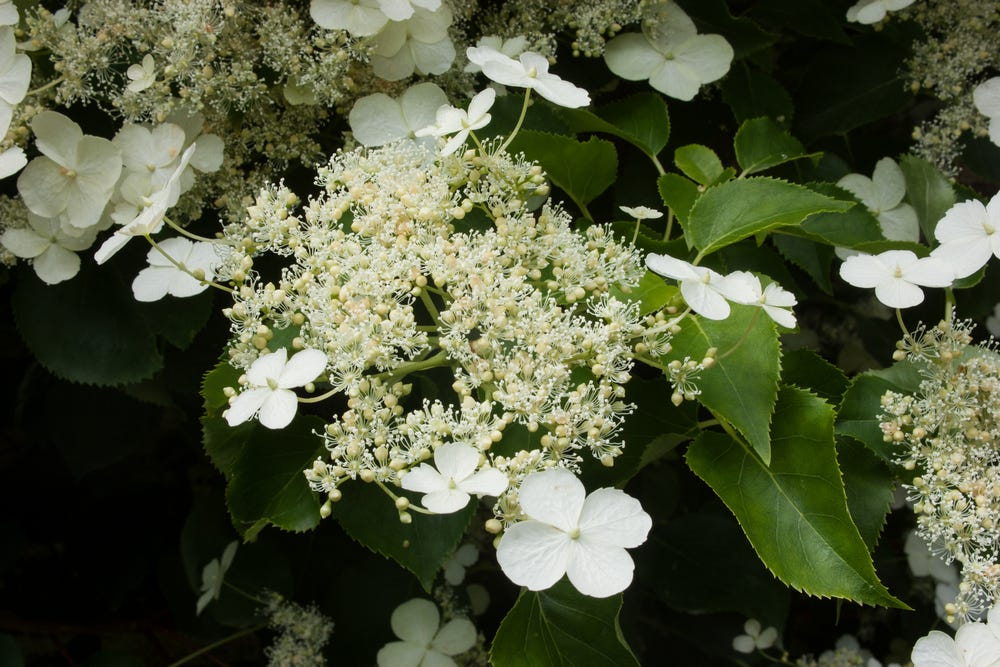
Some climbers are self-clinging, most notably ivy (Hedera helix), Boston ivies (species of Parthenocissus) and the climbing hydrangeas. These have modified roots on their stems that anchor the plant to vertical surfaces like trees and rocks, or fences and walls in cultivation. I’m going to tell you now that there’s no such thing as an effort-free climber; non-self-clinging climbers need good support while self-clinging climbers are always absolutely fine until you need to get them away from their support in order to carry out maintenance. You really appreciate just how tenacious those aerial roots can be when you’re trying to peel them from the wall, and it’s important to note that you will have to cut the plant hard back and start again from the base.
Most climbing plants will need some sort of support, such as wires, frames or trellises, fixed to a vertical surface. My preference is always to use wires because you have greater flexibility with the spacing between them and it’s easier to guide the plant to grow how you want it. Trellises and frames are easier to install, however, and certainly have their uses on smaller areas.
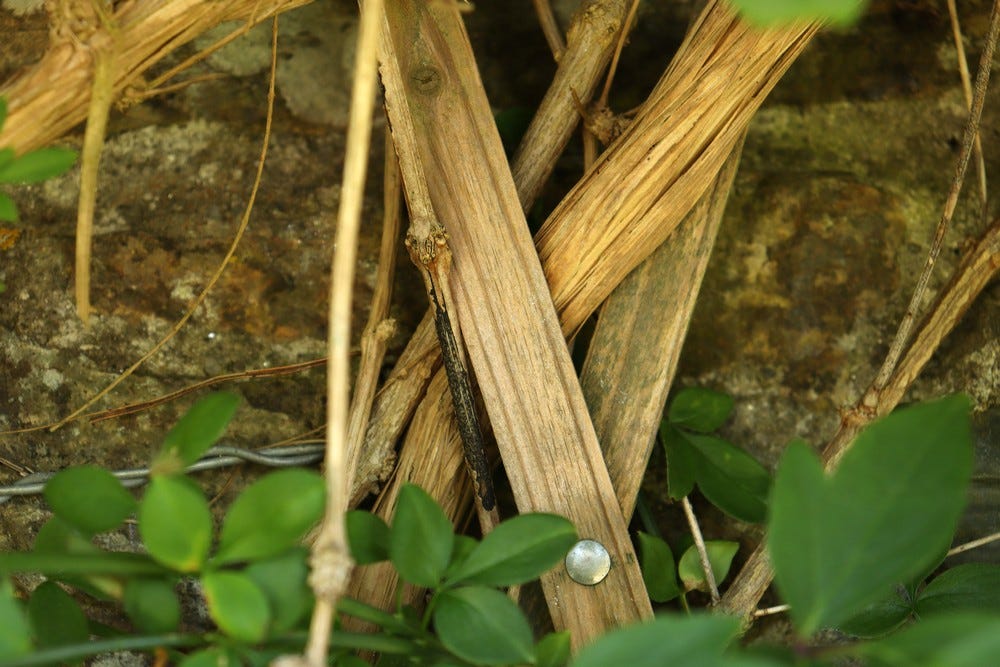
Climbing plants should ideally always be tied to their support, rather than letting them wrap themselves around wires or wooden slats. As climbers grow their stems expand, and this often leads to them making a congested mass of growth which can, particularly in the case of climbers grown on trellis, pull the support off the wall. The stems of wire-grown climbers can end up expanding around their wires; contrary to popular advice this is seldom fatal, but it will invariably compromise the physical strength and integrity of the stem.
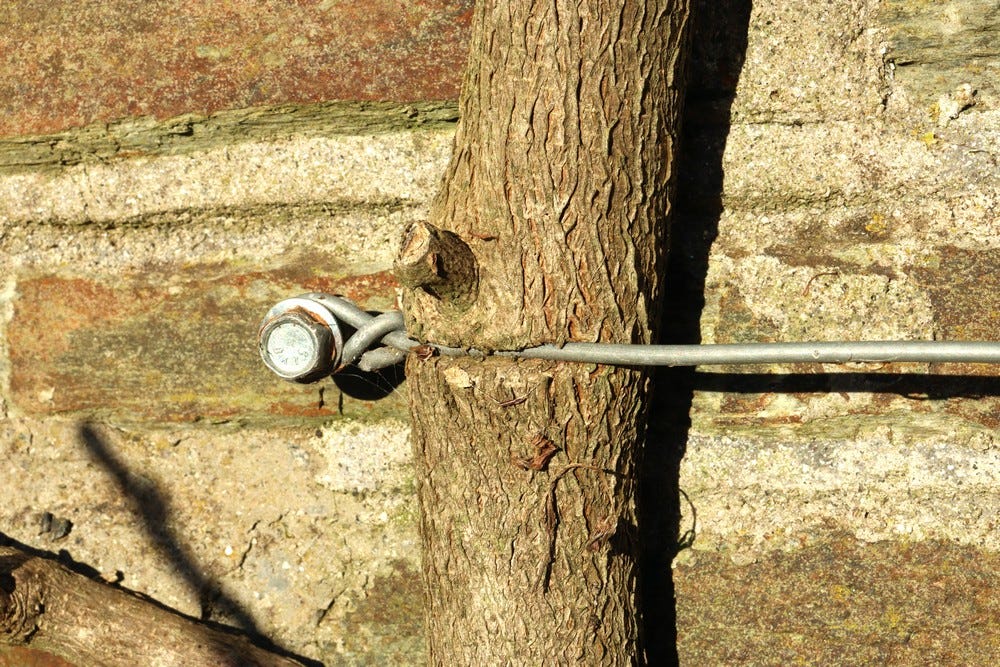
When maintaining climbing plants and supports it’s also worth thinking about maintenance of the wall or fence behind. If a plant is tied to its support then it can be untied and moved away, but if the plant is wrapped around then the only way to move the plant is to sever its stems and remove it and its support.
I know we’re all busy and chasing after climbing plants – especially fast-growing climbers – is not going to be the top of our list of priorities. However it’s worth noting that time saved tucking shoots behind trellis or wire might very well end up be lost if the plant has to be severely hacked later in its life. I would suggest that tying in the shoots of climbing plants at least for the first year or two is time very well spent; if you did need to cut the plant back later to move it away from the wall then at least you have a good framework of shoots at the base to re-establish the plant.
I always use string or twine made from natural materials for tying plants in, and not for any sort of moral reason. The big problem with natural materials is that they rot and don’t last long, but that’s exactly why I use them; they usually fail at the exact point when they need to. Metal wire (including wire covered with plastic or rubber), little wire clips, plastic string and plastic ties all last for much longer, but none are forgiving if plant stems expand. By the time natural materials rot and break it’s usually time to re-tie the plant anyway. Another thing is that it doesn’t really matter if you cut string during routine maintenance but undoing wire can be slow and fiddly.
Ideally try to avoid making a simple loop of string to tie the plant to its support. A loop seldom holds the stem well unless you tie it firmly, at which point there is no room for expansion. It’s not always an issue but I find it much better to use one of two alternative methods. One is to make a figure of 8 with the string, with the plant’s stem in one loop and the support in the other. The bit where the string crosses acts as a bit of a cushion to prevent the plant rubbing against whatever it’s being tied to.
The alternative is slightly trickier but involves making a loop around the stem of the plant and then trying to the support. I find this easier on vertical shoots for some reason.
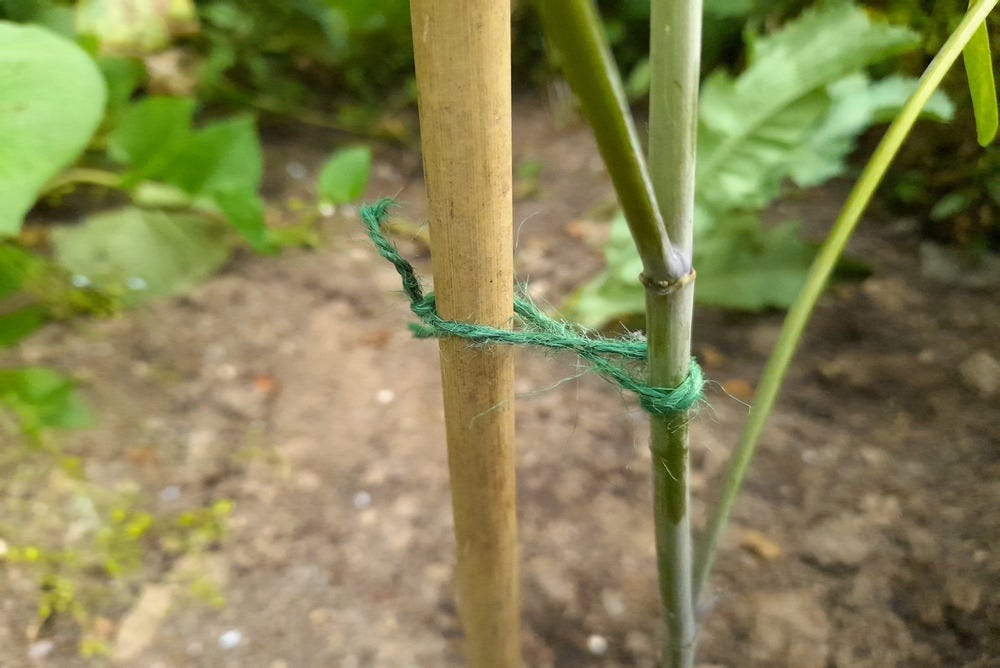
In both cases the string holds the stem in place but slightly away from its support. Climbing plants can end up taking surprising amounts of wind, and because they’re tied against a solid wall or fence the full force of the wind is taken by the plant itself. If the plant was climbing up a shrub or tree, as it would in the wild, the support and the climber would flex in the wind. The trick for the gardener is to provide enough support without tying the plant too rigidly.
It’s much better for the string to fail than the plant. It’s rare for a climber to fall off a support but not unknown, and if the string fails but the plant falls away from the wall unharmed then it’s easy enough to tie back in.
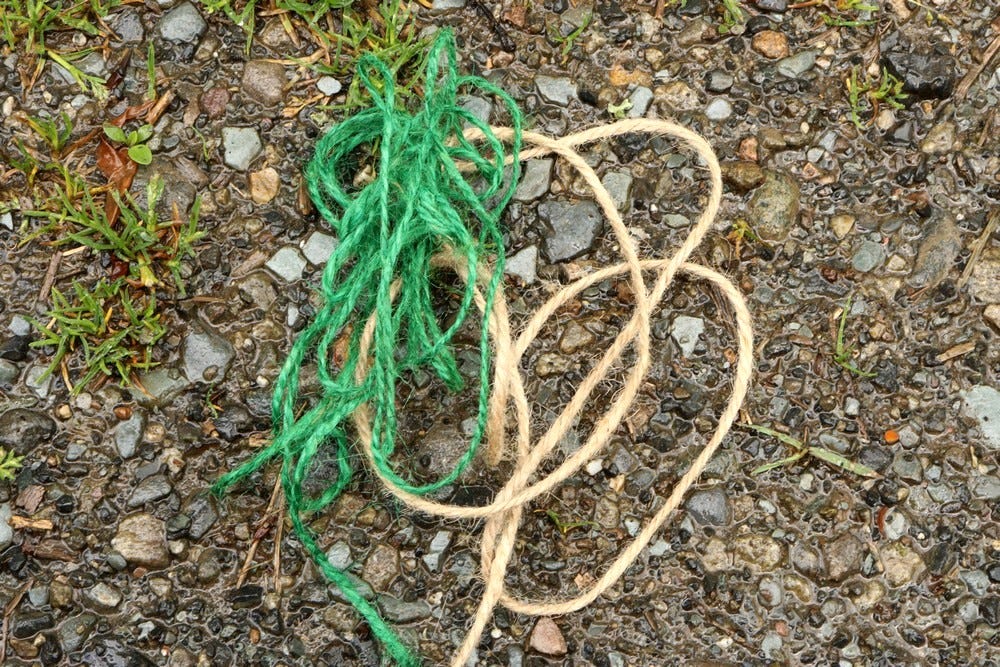
I’ve ended up with two thicknesses of string in my work box. It was just down to me not realising how thick one of the balls of string would be when I ordered it, but it’s not turned out to be a disaster by any means. I found that my normal standard-thickness string was fine for bigger stems but was cumbersome when working with thinner ones. Fate left me with a thin string and I think I’m inclined to keep using two different thicknesses; if you’re looking at two balls of string or garden twine choose the thicker one as it will be the more universally useful.
It’s not just climbing plants that can benefit from being tied in; herbaceous plants and sometimes even shrubs might need a little support. There are many different options available for supporting herbaceous plants, and I use none of them! Because I’m gardening with a low-input system I tend not to get much lax growth that needs supporting, and because I’m growing pretty robust plants it’s not a problem for me if something flops over a little. However some gardens might have a lot more plants in need of support and some gardeners might prefer to tie their plants more rigidly.
It’s much easier to provide support for herbaceous plants early in the season, but this means anticipating which will flop later in the year. If your garden is filled with plants that fall over at the first sign of rain and wind then you have underlying cultivation issues; the majority of garden plants should be able to stand up on their own. That said, a little intervention is sometimes needed.
If you find yourself having to support an herbaceous plant that’s already in full growth then the easiest way is to make a circle of bamboo canes around the base – tucked in underneath the plant if possible so it’s not too obvious – with a loop of string. Sometimes it’s necessary to tie in individual shoots, in which case using the figure of 8 method should hopefully hold the stem to its support.
Believe me when I say that I appreciate how busy gardeners are in the growing season. The numerous and various tying options offered at the nurseries offer long-term solutions that would, in principle, allow the gardener to spend less time maintaining climbers. I don’t think this is a job we should be avoiding though.
Done well, climbing plants add a lot to our gardens and I think it’s worth getting them right. I’ve spent a bit of time over the years trying to sort out problems where climbers have outgrown their supports and where supports have failed; stems being wound, or allowed to wind themselves, around wires and trellis causes enormous amounts of frustration! It might not be entirely possible to avoid cutting a climbing plant hard back to allow access to repair or replace its support, but I can absolutely guarantee that carefully maintaining a basic framework of stems will pay dividends in the long run.
A ball of string has long been a vital tool for gardeners, but as with any tool it’s important to know how to use it. Tying plant stems tightly is usually detrimental to stems, although strings and twines sometimes degrade before they constrict too much. Tying too loosely just means the plant flops around too much. I’d love to be able to give you a neat trick for getting it just right but I’m afraid it all comes down to practice.
Growing climbing plants does mean a bit more work for the usually already busy gardener, but maintenance will pay dividends if done right. If well grown climbing plants will, quite literally, take your garden to the next level.
I have been naughty and wound my wisteria completely through a trellis. The reason I think I can get away with it is that the trellis is attached to three very thick posts into a double skin brick wall, and I expect that rather than hack back the wisteria I will be able to hack back the trellis itself, as it's a pretty cheap one which I did an absolutely awful job of screwing onto the posts. So hopefully one day the plant will be attached to the posts in a sort of trellis pattern, and I'll just have to pull rotting bits of trellis out from in between the big stems.
Hopefully.
Very useful, thank you. I appreciate your expertise.