
Hot
Gardening when the temperature rises.

Well it’s certainly been a rather warm week, and I must say that I’ve not been enjoying it.
I’m an outdoor person, and one definitely better suited to cold winters than hot summers. When the weather is cold and wet I can add extra layers and move around to keep warm. When the combined effect of heat and humidity makes every move a challenge, that becomes a problem.
Some clients have absolutely no empathy for their gardener. The gardener is there to do as much as is humanly possible within the allotted time, and anything below 100% effort and achievement is unacceptable. I’m unlucky to have a couple of jobs where it’s been made totally clear to me that my health and wellbeing is secondary to the client’s wishes, and will replace these jobs as new work becomes available.
Fortunately the majority of people are actually very reasonable. I assume it’s because they’re decent people and they care, but it could also be a reluctance to risk having to find a new gardener. There’s a part of me that still thinks I’m 20 years younger and indestructible, but truth is I’m neither. I love gardens but there comes a point when I must accept my limitations. I want to keep doing what I do for as long as possible, but every gardener should aim to go home each day in good health and without injury.
There’s a bizarre culture in professional horticulture, a sort of reckless machismo. I became aware of it a few years ago when I bought a harness that would help me use my long-reach hedge trimmer. While doing my research I kept coming across comments like if you can’t hold your hedge trimmer for eight hours straight then you’re not a gardener, right to the rather extreme I’d rather be dead than wear such a stupid thing. To hell with them; I bought the harness and it’s helped me to be more efficient and using the hedge trimmer for prolonged periods is considerably easier.
The same attitude exists around heat in summer. I refuse to feel bad about being cautious, especially by those people currently wanging on about the summer of 1976 when parts of the UK had temperatures peaking at 36°C, or 97°F. I’m sceptical of the accounts I’m hearing; I wonder how many people who remember that summer so fondly were adults at the time, with adult responsibilities, let alone people who were working outdoors? Heat is great if you’re on holiday and have nothing to do other than lounge around in the shade and drink cold drinks, but it’s a different prospect when your livelihood depends on your ability to work full days outdoors and stay healthy.
It’s one of the many nuances conveniently ignored by those keen to make out that people nowadays are all crybabies. Another thing that’s quietly missing from the rose-tinted view of 1976’s heat wave is that around 100 people died during the 15 days, of causes directly connected to the heat, and there were numerous reports of accidents and injuries. Different people doing different jobs, with different obligations and different lives have different experiences. Anyone trying to look after animals, plants or other people will have their own thoughts on what conditions are good.
If predictions come true and we do get more of these spells of baking hot weather, how will gardeners manage? Home gardeners generally have the freedom to start and stop whenever they like. Nobody is standing over you to ask why you’ve stopped for a long lunch or why you’re sitting in the shade of a tree to recover from the heat, and there’s greater flexibility around how you approach your garden. If the roses don’t get dead-headed until next week it’s not the end of the world.
The life of a professional gardener, especially a freelance gardener, is quite different. You’re in a garden for a set amount of time, and if when you’re not in the same garden every day there’s less flexibility to defer tasks. You do whatever you can and move on to the next thing.
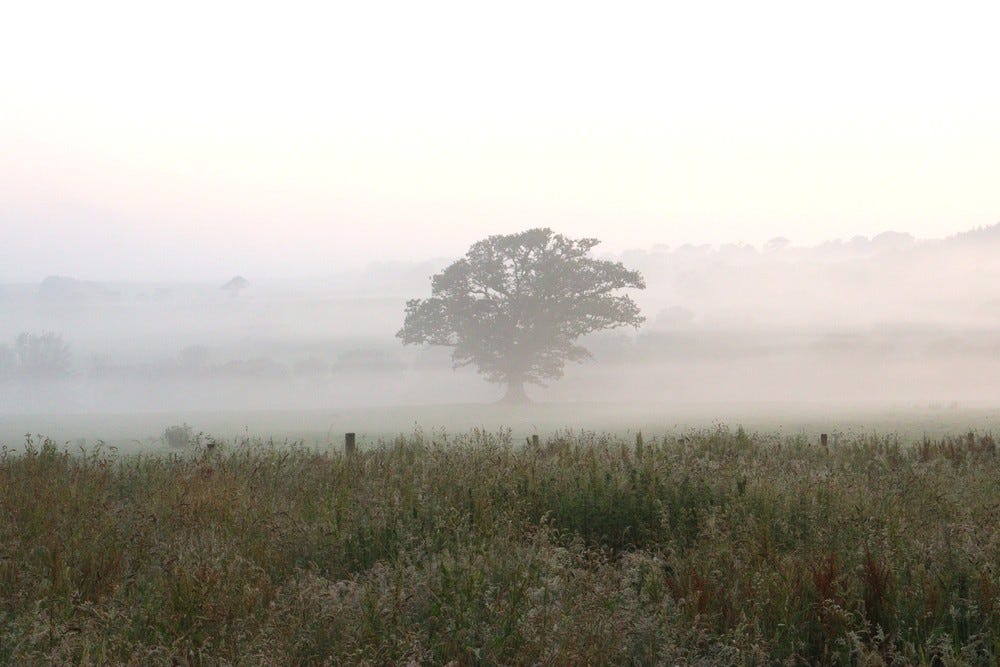
I don’t care where any of you are on the climate spectrum, from hardcore sceptic to devout disciple: when it’s hot we all gravitate to the shade. It’s a horrendous flaw that the so-called climate change gardens are not planting lots of trees. I know that there’s a lot of complicated thinking about trees of certain provenances and all that stuff, plus we have the problem of how to get trees for the climate of tomorrow through the climate of today, but surely we should be planting as many trees as possible, across a wide range of species, so that at least some things are there to cast shade in 20, 30, 40, 50 years and more? We can always thin some out if we need to, assuming nature doesn’t thin them out for us.
We have a strange relationship with sunshine in Britain, not to mention and apparent dogged determination to stick with models of gardening based around spaces being open to the sky. The prevailing idea appears to be that the gardens of the future will be like those of today – completely open to the sky – but will simply use plants from warmer and drier climates to replace the plants we grow today. I’m hugely sceptical of this approach; within hot countries there is enormous ecological nuance.
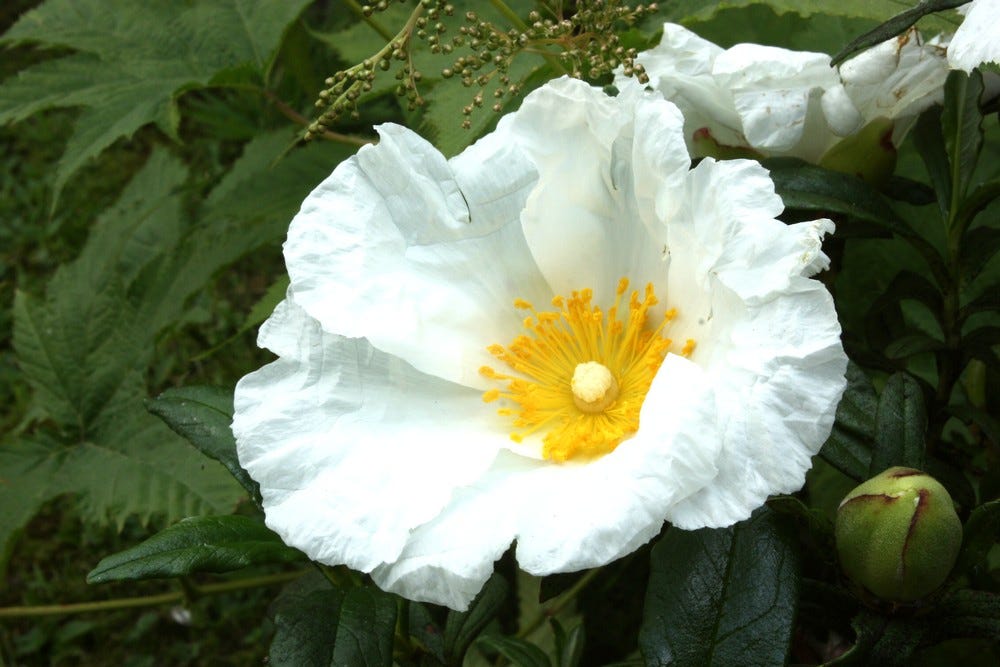
Cistus, for example, can be rather hit-and-miss in British summers despite coming from hotter and drier places. If the plant roots deep into the soil, as it would in the wild, the top of the plant will be fine because its roots are cool and damp. If those roots are confined to the drier and warmer upper parts of the soil the plant is far more likely to suffer when it gets hot. I can’t help thinking nurseries should be growing more plants in deep ‘rose pots’ to encourage root systems to go down.
A lot of the plants being touted as suitable for a hotter future in the UK are adapted to niche conditions in their native environments. They take the heat because conditions at their root conditions are optimal, for example because their roots travel deep into rocky ground to find moisture and cool conditions. I suspect that a great number of the plants currently touted as heat resistant will end up proving disappointing in the conditions that will be inevitably be unique to Britain, and also that at least some of the plants currently expected to fail will end up persisting in gardens.
The key to gardening for the future is not guesswork, it’s planting diversity.
An interesting trend is the use of crushed concrete or other non-organic substrates as a growing medium, as notably demonstrated by the walled garden on the Knepp Estate and, to a lesser extent, the rather baffling new garden at Regent’s Park in London. The idea behind growing plants in non-organic substrates is still marginal but isn’t particularly new. Experimental gardeners like Peter Korn and John Little have been doing it for years; Korn uses a particular grade of sand while Little uses anything he can get hold of. A lack of organic matter forces plants to build symbiotic relationships with mycorrhizal fungi, associations they wouldn’t really make when there is plenty of organic material in the soil.
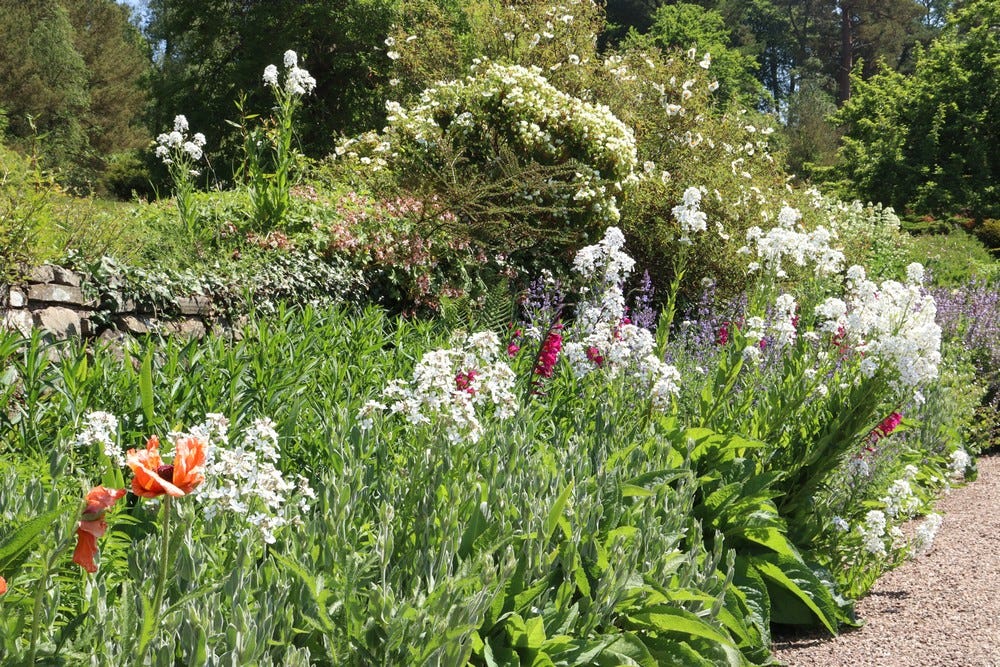
The key to this is to make sure there is as little organic matter as possible, to force the plants to adopt a different way of growing. This is what makes the Regent’s Park project a bit baffling; they’ve taken crushed concrete and mixed it with the existing soil. The result is soil with bits of concrete in it; neither a rich soil with plenty of organic matter not a depleted substrate that forces plants to fend for themselves. They appear to have created the exact sort of conditions gardeners with new-build homes have been struggling with over the years, but are now expected to become a miracle option.
I’m actually a big fan of the depleted substrate model of growing, in certain situations. The strength of the principle is that it takes material that would ordinarily be removed from the site and makes it into something attractive. The weakness at the Knepp garden is that they took fairly good underlying soil and covered it with imported crushed rubble, but it has popularised the idea that there are alternative ways to grow plants. Knepp’s walled garden is both a prime example of what can be done and also what shouldn’t be done.
Use what you have rather than importing.
While it’s interesting to see at least some of these projects develop, given the general success of non-organic substrates and of course the time-honoured practices of maintaining healthy organic soil, I’m going to be a little sceptical about Regent’s Park for the time being. I have this discomforting sense that this ‘pioneering project’ will turn out to be a bit of a let-down in years to come. A plot of soil with a load of concrete rubble in it.
But all this innovation in planting is one thing, but what about the innovations in gardening that will need to go with it? As temperatures increase the actual work of gardening will become more challenging.
When it gets uncomfortably hot the home gardener has the option to work very early in the morning, rest or do something else during the hottest part of the day, then go back outside when it cools off. That model would be a bit more challenging for professional gardeners, especially those who don’t live near their place of work. The split shift model of work is fairly common with chefs, but it narrows options in these cases for both employees and employers.
In some places gardens might adopt a night shift during the hottest weather, with gardeners working under artificial light from midnight to early morning before going home. This wouldn’t be practical in gardens where people are trying to sleep in the house, or where there are close neighbours, but it might very well become an option in some places.
We really should look seriously at ways of shading even just parts of a garden. I’ve been weighing up whether I need to bring my own shade in the form of a folding gazebo, big parasol or something similar, something I can set up to cast shade if I can’t avoid the sun. The only problem is that these things are quite heavy to carry around gardens on my own and won’t provide a big enough area to keep me shaded for long. However it might be worth considering in some gardens, especially those where the job of moving and erecting the thing can be shared with others.
The best option is to use the gardener’s greatest asset: their brain. By accepting that during periods of excessive heat in summer gardens will need to be managed differently, it really should be possible to manage workload during periods of excessive heat in precisely the same way we do when it’s raining or cold. The best gardeners aren’t just the ones who know how to plant and prune, but also know how to manage their time. There are usually jobs that can be deferred and others that can be brought forward.
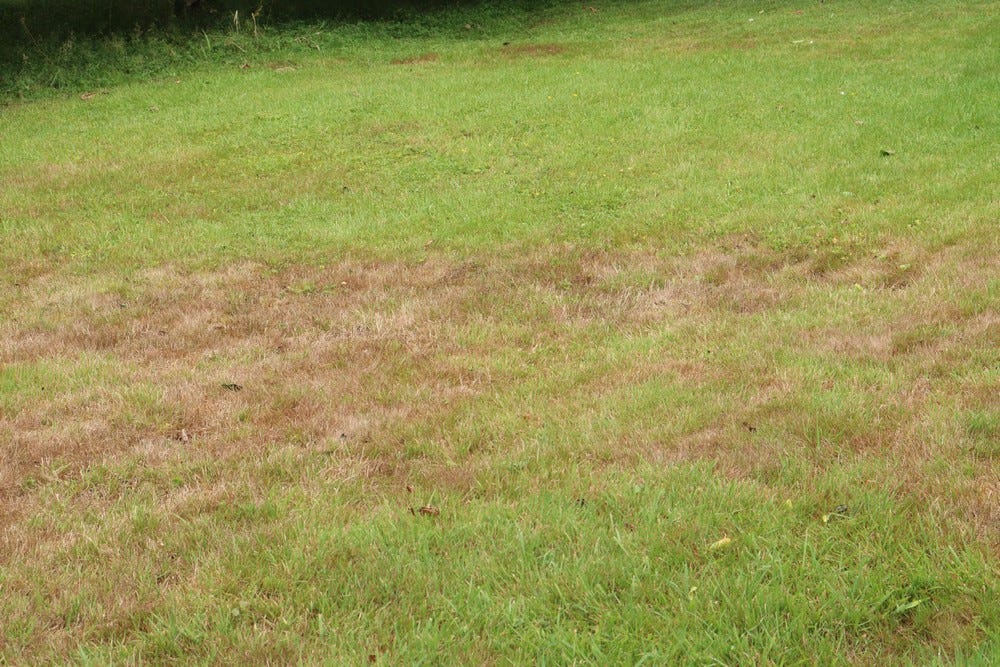
It’s not in fact the end of the world if some tasks are neglected for a while.
Fun as it may be for social commentators to complain that people these days aren’t up to various arbitrary standards allegedly maintained by previous generations, we must be realistic about what can and should be achieved. The prevailing commentary seems to suggest that the summer of 1976 was one of hedonistic joy; there’s a gentle ignoring of the water shortages, excess deaths and injuries and other documented challenges of the time. Life might well have been great for children and young adults, but it wasn’t for everyone.
British heat is humid heat. There are hotter places in the world of course, but the combination of heat and humidity makes physical work particularly challenging. Our bodies regulate their temperatures by sweating, and when it’s humid that sweat doesn’t evaporate so that cooling is less efficient. Even if you don’t have underlying medical issues it can be very challenging to do anything laborious, but there are people out there whose jobs demand that they work outside and it’s fair and appropriate to consider their wellbeing.
Gardeners, like farmers, builders and anyone else used to working outside, work through a wide range of conditions through the year. Builders can work with fans that help them stay cool and can often change work around to take advantage of certain conditions (although I know builders who have clocked off early even here in the South West, where the heat was marginally less extreme), and farming is largely mechanical now and modern tractors have air conditioning to help farmers work through hot weather. Gardening is still very physical and there is little that can realistically be done to change that.
We must accept that different people have different tolerances, and start looking seriously at how to make provision for those tending gardens during hot weather.
Provision of shade will absolutely be a key part of gardening in the future, especially keeping hard surfaces and substrates like gravel and crushed concrete cool. Hard surfaces absorb and reflect a lot of heat – you can even feel it through your shoes and boots if you stand still long enough – and reducing this will be an important part of keeping gardens comfortable for everyone.
Yes of course there are plants that will tolerate extreme heat – tolerating heat is different to actually thriving in it – but the focus on plants for the future neglects one of the very most important facts of gardening.
Gardens are about people, not just about plants. A garden might well bask in the sun but people are rightly, sensibly, drawn to the shade. By far the most important consideration when we talk about gardening for a warmer future must be to provide a comfortable experience for garden owners, garden visitors and also anyone involved in caring for gardens.
I couldn’t agree with you more. There is a certain section of the population who seem to think it’s OK to call people weak and pathetic for just basically looking after their health. I listened to a radio programme yesterday where people were ringing in to complain about some schools closing because of the heat. If you’ve never done a job, you have no idea how hard it is but a bit of common sense and empathy would help. I’ve been watching a team of landscapers laying a driveway for the last couple of days and couldn’t help thinking it might have been more sensible to leave it for a couple of days. There was no shade at all and it was 35 degrees yesterday. Maybe they’ve got loads of jobs on and can’t afford to stop?
Really really good points. Big cherry tree in our garden just died and we're feeling the lack of its shade severely.